On Those Who Have No Lines

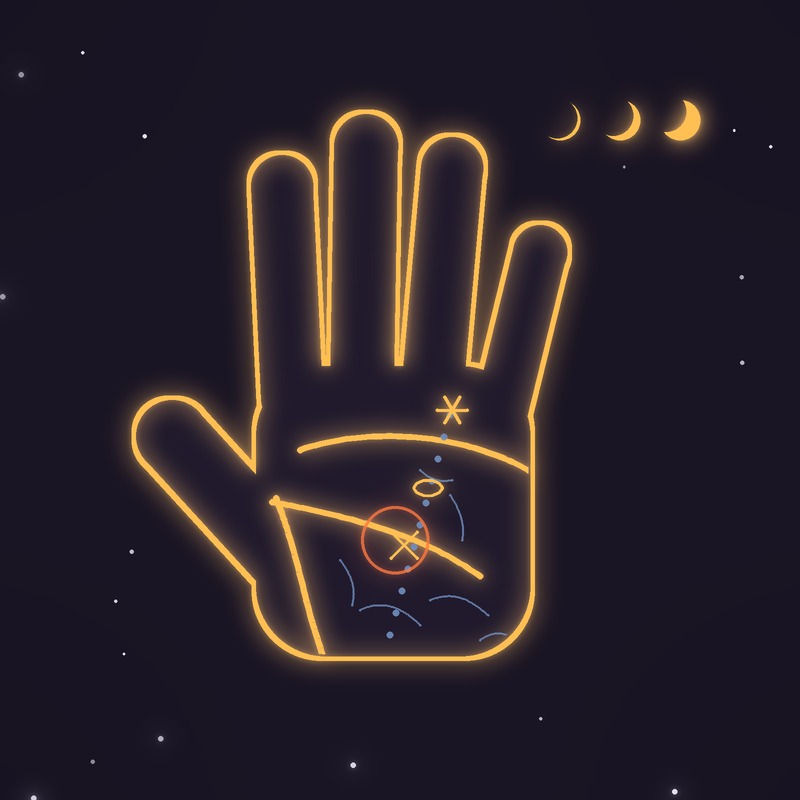
I. There are people on whose palms there is not a single line. Neither the chief creases nor the small ones, nor the pattern on the pads of the fingers. The skin is smooth, even, like a wax doll's, like an eggshell, like a sheet of paper on which nothing has yet been written. They are called the lineless. There are few of them. But there are more than is commonly thought, because a lineless one does not show his hands.
II. The lineless are of two kinds, and they must be told apart before anything else, because to confuse them is the most dangerous mistake a reader can make.
III. The lineless of the first kind were born so. It runs in certain families from generation to generation: the father has smooth fingers, the son smooth, the grandson smooth. They live like everyone else, marry, work, fall ill and die in their own time. Their hands cannot be read, but there is neither evil nor mystery in this: their fate is simply written not on the hand but somewhere else, as some people keep their money not in a purse but in a boot. Their handshake is warm. They may be trusted as much as anyone else, no more and no less.
IV. The lineless of the second kind were not born so. They became so. They had lines, and then the lines went away, one after another, as tenants leave a house marked for demolition. Three ways are recorded by which the lines go.
The first way: from a burn, a cut, a disease of the skin, when the skin comes away in a flap and new, smooth skin grows in its place. This way is harmless, and the lines as a rule come back in time, at least in part.
The second way: from frequent reading. One whose hand is read every month for many years grows pale in the palm, as cotton print grows pale from washing, and in the end his palm becomes almost smooth, and he himself becomes quiet, calm and empty.
The third way: from selling. They say lines can be sold. They say there was a man who sold all his lines, to the last one, at a single stroke, for a gift of which nothing is said here, and since then he has walked without them. They say he walks to this day.
V. The marks of the lineless one of the third way, written down by those who saw him or thought they saw him:
- he does not knock at the door, but the door turns out to be open;
- his steps are not heard on stone, nor on iron, nor on a creaking floorboard;
- his face can be seen but is not remembered; you look at it as through clouded glass, and the eye slides off it like fingers off wet soap; a minute later you cannot say whether he had a nose;
- he is always dressed the same, in something long and dark, down to the heels;
- his hands are gloved, and when he takes off a glove his palm is smooth and cold, with pale half-moons on the nails, and there is nothing on it but, in some accounts, a white scar at the base of the thumb;
- his voice is quiet and as if from far away, like a voice from a well;
- he writes in an old hand, small, sharp, with flourishes such as no one has written for a long time, and his ink is brown, like rust;
- after him, on the chair where he sat, there remains a small lump of damp earth, the size of a fingernail.
 VI. A rule is written down: the lineless one is not read. There is nothing to read, say some. It is not allowed, say others. Others again say that it can be read, but the reader will see in his palm not his month but the reader's own, and will see his own month as the lineless one sees it. And from that day the reader himself becomes visible to the lineless one, as a fire in a window is visible from a dark road.
In the margin, in another hand: and some say he must be read. Once a month. Without refusing. From whoever refuses, he will take it himself.
VII. It was asked: what does the lineless one of the third way seek? The answer was: lines. He sold his own and wants them back, but they are not given back; they can only be gathered anew, one by one, from other hands. But not every hand will do. They say only the hands of one kin will serve him, the kin he came from, one hand from each generation. They say also that these generations are seven, and that when he has gathered the seventh hand he will have lines and a face, and he will go out into the world a living man, and no one will know him, because the face he has will be someone else's.
VIII. There is one way to tell the lineless one of the first kind from the lineless one of the third way, and it is a sure one. Give him your hand. The palm of the first is warm. The palm of the third is neither warm nor cold, but nothing at all, like water in a well, whose temperature the hand does not feel until you take it out into the air. And when you take it out, the hand begins to ache.
IX. There is, they say, a third kind as well, spoken of in whispers and rarely. It happens that in a person quite ordinary, with a palm written all over with lines, the palms suddenly, in a single night, become smooth as a newborn's, and this person comes back from somewhere where he has been for five or seven days, and does not remember where he was, and is silent, and looks through people. Such ones, they say, he took with him but did not keep. He let them go. What he took from them in exchange is not known. It is written that beside such people it is quiet, as in an empty church, and that their hands, if held long in one's own, neither warm nor chill but soothe, and that in some of them, in time, a first line shows through, faint as a single hair against the light.