On Payment

I. Every reading has its cost. It costs not the one who reads alone, nor the one whose hand is read alone, but both; and it is paid not in what is seen, but in what is not seen. Whoever says he reads for nothing either lies or does not know who is paying for him.
II. An old saying is written down: take nothing for this yourself; whoever takes, gives back later. It is understood in two ways. Some understand it to mean that to take money for reading is a sin, as it is a sin to sell water to the thirsty. Others understand that money has nothing to do with it, and that nothing at all should be taken, because whoever takes becomes a debtor, and the debt will not be collected in what he took.
III. Those who take nonetheless take silver. Copper, they say, will not do; paper will not do at all: to take paper for a reading is like carrying water in a sieve. Silver holds. What exactly it holds is not said.
IV. There is a rule repeated in many copies: do not take his payment with a bare hand. Whose payment "his" is, the copies do not explain, as if everyone who has reached this place ought to know for himself. One is told to take it through a handkerchief, through the skirt of a coat, through a leaf, through anything at all, so long as the skin does not touch it. They say whoever touches it will learn where this payment comes from, and, having learned, will never again be able not to know.
V. Coins are described that are sometimes found where no one left them: on a table by a door, on a threshold, on the stone over a grave, stacked in an even column, like change in a till. These coins are of old minting, dark, almost black, heavy beyond their size, with an uneven edge, as if gnawed. On one side they bear a profile, worn so that one cannot make out whose. It has been noted:
- these coins are cold, colder than the stone they lie on, and do not grow warm in the hand;
- wet, they do not shine, but seem to soak up the water;
- however many of them there are, they all fall profile up, however they are thrown;
- the profiles on them look not straight ahead but to the side, and always the same way: towards where the one looking at them is sitting;
- if one looks at a profile long enough, it begins to seem familiar.
 VI. They say that on each such coin is the face of a person, and the coin itself is a month of his life, cut off and minted. They say these months were taken in payment for readings, and that every reading cuts from the fate of the one read a piece, thin as a shaving, unnoticed, and once a month someone comes and gathers the shavings into a coin. They say these coins are brought to the one who reads and left for him, as the takings are left for the owner of a shop. And they say these coins should not be taken, because they are not payment to him but payment for them.
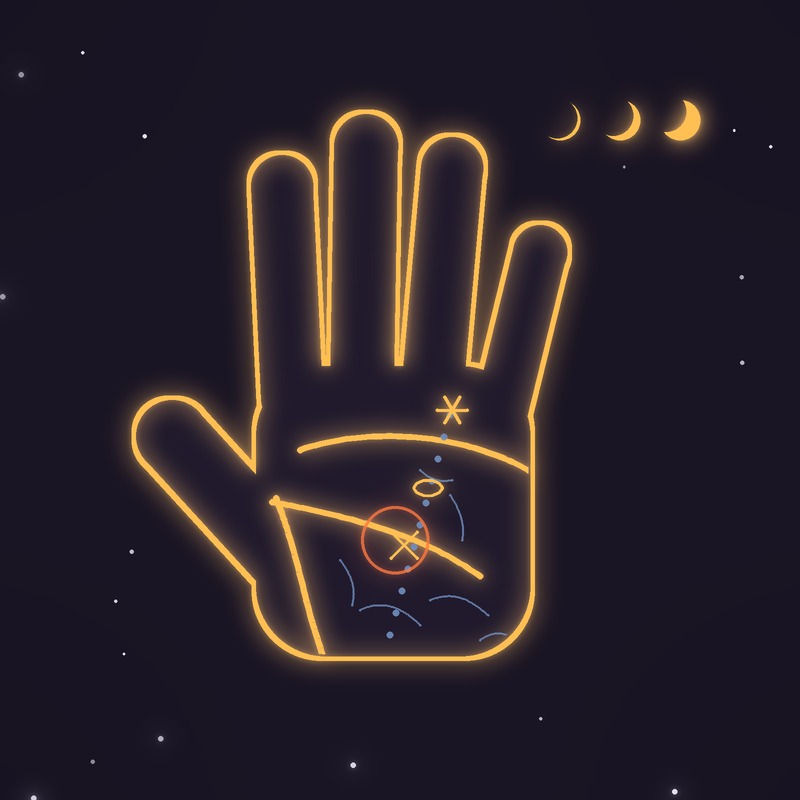
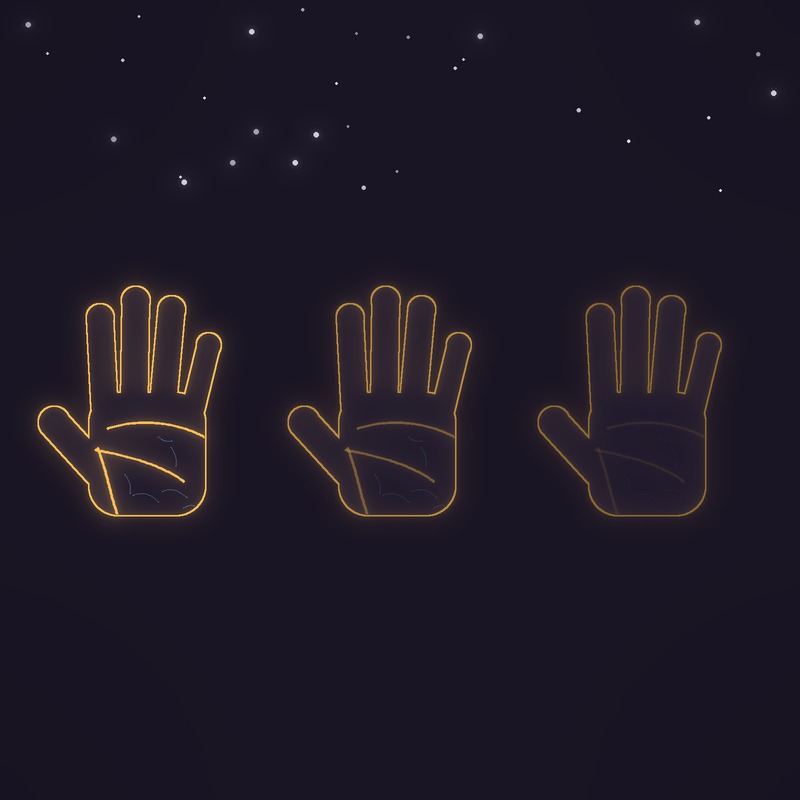
VII. Hence the chief observation about payment, written in every copy with the same unease. One whose hand is read once notices nothing. One whose hand is read often, every month, for years, grows pale in the palm. First the small, fine lines go, then the chief ones grow shallow, then the palm becomes like washed-out cotton print, on which a pattern can barely be guessed. And the person himself becomes quiet, calm, content with everything, and wants nothing any more. Such people were later found sitting on benches by gates, in rows, like sparrows on a wire, and they all looked the same way, and they were all calm, and none had lines on their palms.
In the margin, in another hand: they do not complain. They are waiting for their months back.
 VIII. A question is written down that readers are asked by their regular guests: why do I feel so good with you, why is it so quiet after your parchment, why do I come back every month? And the answer readers give, if they give one, is written down: because each time you leave a little of yourself here, and you feel lighter, as one feels lighter who pays his debts. But these debts are not yours.
IX. Whose payment it is and to whom, the copies tell differently, but on one thing they agree: it is not the one who received the gift who pays for it. Those pay who come to the one who received it. And the one who received it pays otherwise, in another coin, and once a generation. In what coin is not said here.
X. And the rule on which the record breaks off. Payment is not returned, what is said is not taken back, what is written is not struck out. No refunds. They say this was written not for those who pay but for the one who collects the payment: he too cannot return what he has taken, and he too cannot undo what is written. Some saw in these words a sentence. Some, they say, saw in them a weapon.